In natural English, words do not stop and start. They link, sounds change or drop, and small words shrink. Here are all 31 rules the Accenty app teaches, in 8 families, each with examples and the mistake to avoid.
pick it up→pick‿it‿up
Accent
‿ words joinp sound changest sound dropsə weak vowel
Linking
Words run into each other instead of stopping between them.
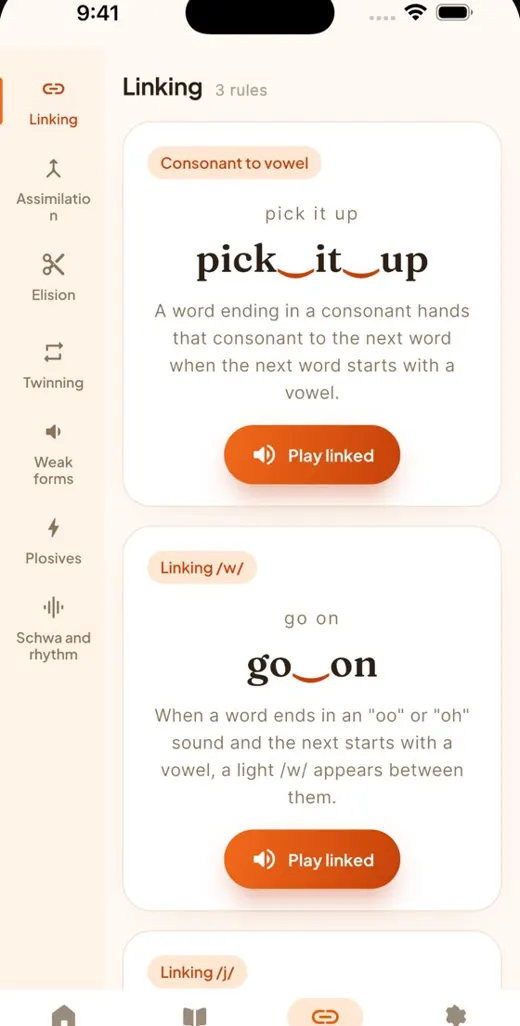
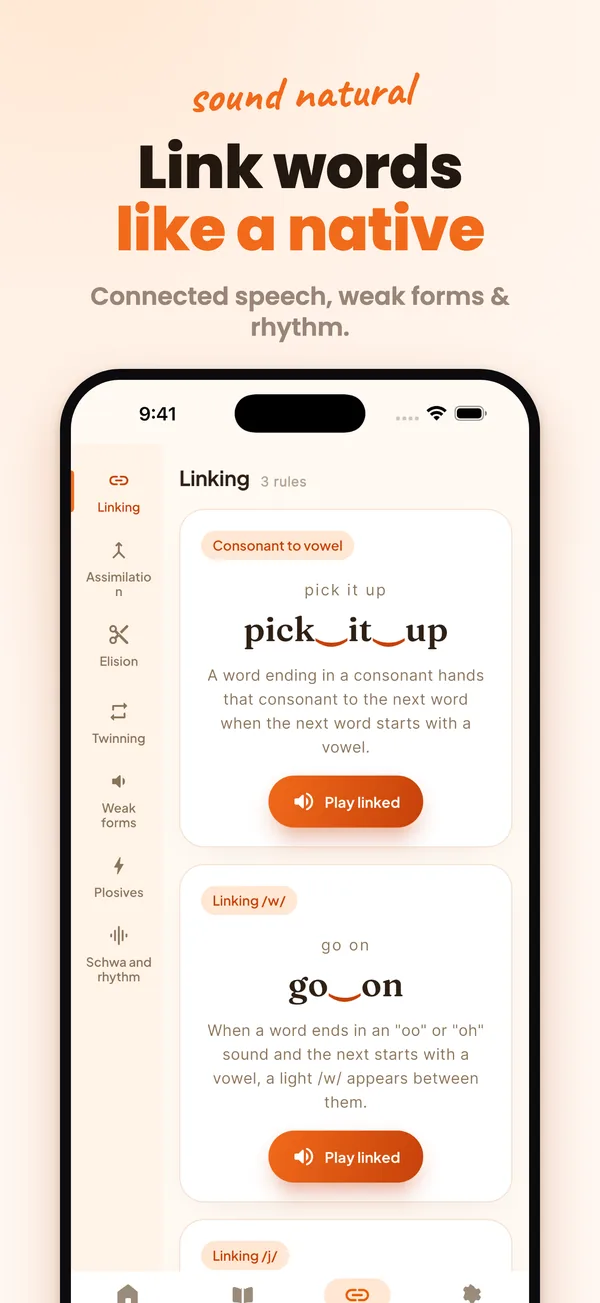
Consonant to vowel
A word ending in a consonant hands that consonant to the next word when the next word starts with a vowel.
pick‿it‿up/pɪ.kɪ.tʌp/Word by wordpick it upIn real speechpick‿it‿upCan you pick it up for me?
an‿apple/ə.næ.pəl/Word by wordan appleIn real speechan‿appleShe ate an apple.
turn‿it‿off/tɜː.nɪ.tɒf/Word by wordturn it offIn real speechturn‿it‿offTurn it off before you leave.
not‿at‿all/nɒ.tə.tɔːl/Word by wordnot at allIn real speechnot‿at‿all
💡 Why it happens
English speakers do not restart their voice between words. The consonant needs a vowel to lean on, and the vowel next door is the nearest one, so the syllable boundary moves: "pick it up" comes out as "pi-ki-tup".
⚠️ Common trap
Putting a tiny pause between every word. It sounds careful to you and choppy to a listener, and it is the single biggest reason learners get asked to repeat themselves. If your speech sounds like a list, this is the rule to fix first.
Linking /r/
British English
In British English a written "r" at the end of a word is silent, unless the next word begins with a vowel. Then it comes back.
far‿away/fɑː.rə.weɪ/Word by wordfar awayIn real speechfar‿awayIt is not far away.
four‿eggs/fɔː.regz/Word by wordfour eggsIn real speechfour‿eggs
here‿and there/hɪə.rən.ðeə/Word by wordhere and thereIn real speechhere‿and there
💡 Why it happens
British English is non-rhotic: "far" on its own ends in a vowel. But the "r" is still in the spelling and still in the speaker's head, and a following vowel gives it somewhere to go, so "far away" becomes "fa-raway".
⚠️ Common trap
Dropping the "r" everywhere once you learn British English is non-rhotic. "Four eggs" without the linking "r" sounds like two separate ideas. The rule is not "never say r", it is "say it when a vowel follows".
Linking /w/
When a word ends in an "oo" or "oh" sound and the next starts with a vowel, a light /w/ appears between them.
go‿on/ɡəʊ.wɒn/Word by wordgo onIn real speechgo‿onGo on, tell me.
do‿it/duː.wɪt/Word by worddo itIn real speechdo‿it
how‿old/haʊ.wəʊld/Word by wordhow oldIn real speechhow‿old
💡 Why it happens
Your lips are already rounded at the end of "go" or "do". Opening them into the next vowel passes through a /w/ on the way. Nobody decides to add it; it falls out of the mouth position.
⚠️ Common trap
Forcing a hard "w" as if it were spelled. It should be barely there. If "go on" sounds like "go won" as two clear words, you have overdone it.
Linking /j/
When a word ends in an "ee" or "eye" sound and the next starts with a vowel, a light /j/ (the "y" sound) appears between them.
law‿rand order/lɔː.rən.ɔː.də/Word by wordlaw and orderIn real speechlaw‿rand order
idea‿rof/aɪ.dɪə.rəv/Word by wordthe idea of itIn real speechidea‿rof
media‿revent/miː.dɪə.rɪ.vent/Word by wordmedia eventIn real speechmedia‿revent
💡 Why it happens
Linking /r/ becomes such a strong habit that the mouth applies it to any vowel-vowel seam. "Law and order" has no "r" after "law", but the gap gets filled anyway.
⚠️ Common trap
Do not chase this one. It is worth recognising so British speech does not confuse you, but adding it deliberately in the wrong place sounds odd, and plenty of British speakers consider it sloppy. Understand it, do not drill it.
Assimilation
A sound changes to get ready for the sound that follows.
/t/ before /p/ and /b/
A final /t/ turns into /p/ when the next word starts with /p/ or /b/.
thap person/ðæp ˈpɜː.sən/Word by wordthat personIn real speechthap person
whip paper/waɪp ˈpeɪ.pə/Word by wordwhite paperIn real speechwhip paper
hop bath/hɒp bɑːθ/Word by wordhot bathIn real speechhop bath
💡 Why it happens
Your lips have to close for the /p/. Rather than touch the tongue to the ridge for /t/ and then close the lips, the mouth skips a step and closes the lips early, which turns the /t/ into a /p/.
⚠️ Common trap
Trying to pronounce a clean /t/ there. It is not wrong, it just marks the speech as careful and slow. Native speed makes this change automatically.
/t/ before /k/ and /g/
A final /t/ turns into /k/ when the next word starts with /k/ or /g/.
thak cup/ðæk kʌp/Word by wordthat cupIn real speechthak cup
shork cut/ʃɔːk kʌt/Word by wordshort cutIn real speechshork cut
thak girl/ðæk ɡɜːl/Word by wordthat girlIn real speechthak girl
💡 Why it happens
Same shortcut as before, in the other direction. The back of the tongue is already rising for the /k/, so the /t/ moves back to meet it: "that cup" becomes "thack cup".
⚠️ Common trap
Hearing "thack" and assuming you misheard. Learners often decide the speaker made a mistake. They did not; this is the normal form at speed.
/n/ before /p/, /b/ and /m/
A final /n/ turns into /m/ before a lip consonant.
tem pounds/tem paʊndz/Word by wordten poundsIn real speechtem pounds
im bed/ɪm bed/Word by wordin bedIn real speechim bed
owm boat/əʊm bəʊt/Word by wordown boatIn real speechowm boat
💡 Why it happens
The lips must close for /p/, /b/ or /m/. Closing them a moment early converts the /n/ into an /m/, because /m/ is simply /n/ made with the lips instead of the tongue.
⚠️ Common trap
Writing it off as a regional accent. "Tem pounds" is standard connected speech, not a dialect.
teŋ cars/teŋ kɑːz/Word by wordten carsIn real speechteŋ cars
iŋ Greece/ɪŋ ɡriːs/Word by wordin GreeceIn real speechiŋ Greece
greeŋ colour/ɡriːŋ ˈkʌ.lə/Word by wordgreen colourIn real speechgreeŋ colour
💡 Why it happens
The same lazy-in-a-good-way move, pulled backwards: the tongue is heading for the back of the mouth for /k/, so the /n/ is made back there too and becomes the "ng" sound.
⚠️ Common trap
Over-correcting into a clear /n/ plus a hard /k/. "Ten cars" said that carefully has an audible break in the middle that native speech does not have.
/d/ before /g/
A final /d/ turns into /g/ before /g/ or a hard /k/.
meetʃyou/miː.tʃuː/Word by wordmeet youIn real speechmeetʃyouNice to meet you.
don'tʃyou/dəʊn.tʃuː/Word by worddon't youIn real speechdon'tʃyou
lastʃyear/lɑːs.tʃɪə/Word by wordlast yearIn real speechlastʃyear
💡 Why it happens
This one is a merger, not a replacement: /t/ and /j/ meet in the middle and produce a sound that is genuinely between them. It is the reason "meet you" and "meacher" sound almost identical.
⚠️ Common trap
Assuming this is slang. "Nice to meet you" with a full /t/ and a full "you" is perfectly grammatical and sounds like a language lesson. The "ch" version is what people actually say, including in formal settings.
/d/ + "you" becomes /dʒ/
When /d/ meets the "y" sound, the two fuse into the "j" of "judge".
next day/neks deɪ/Word by wordnext dayIn real speechnext day
last night/lɑːs naɪt/Word by wordlast nightIn real speechlast nightI saw them last night.
must be/məs biː/Word by wordmust beIn real speechmust be
💡 Why it happens
Three consonants in a row is hard work, and the middle one carries the least information. "Next day" keeps the /k/, /s/ and /d/, all of which you need, and drops the /t/, which you do not.
⚠️ Common trap
Believing the word is being mispronounced. Learners often listen for the /t/ in "last night", fail to find it, and lose the sentence. Train your ear to expect the gap.
Dropped /d/
A /d/ between two consonants goes the same way as /t/.
tell him/tel ɪm/Word by wordtell himIn real speechtell himTell him I called.
ask her/ɑːsk ə/Word by wordask herIn real speechask her
give him/ɡɪv ɪm/Word by wordgive him a handIn real speechgive him
💡 Why it happens
These are function words: they carry grammar, not meaning, so speech gives them as little air as possible. The /h/ is the first thing to go.
⚠️ Common trap
Applying it to the first word of a sentence. "Him I called" is wrong; "tell im I called" is right. The /h/ survives when the word is stressed or leads the clause.
Dropped syllable
Some words lose a whole unstressed syllable: "camera" has three syllables on paper and two in speech.
bigame/bɪɡːeɪm/Word by wordbig gameIn real speechbigame
badog/bædːɒɡ/Word by wordbad dogIn real speechbadog
stopushing/stɒpːʊ.ʃɪŋ/Word by wordstop pushingIn real speechstopushing
💡 Why it happens
Saying /g/ twice would need two separate closures and two releases. Speech makes one closure, holds it, then releases: the length is what tells the listener there are two words.
⚠️ Common trap
Releasing both. "Big game" with two audible /g/ sounds has an extra beat in it and sounds mechanical.
Twinned fricatives
The same rule for hissing sounds: "bus stop" has one long /s/, not two.
fish ən chips/fɪʃ ən tʃɪps/Word by wordfish and chipsIn real speechfish ən chips
bread ən butter/bred ən ˈbʌ.tə/Word by wordbread and butterIn real speechbread ən butter
you ən me/juː ən miː/Word by wordyou and meIn real speechyou ən me
💡 Why it happens
English rhythm puts beats on content words and rushes everything between them. "And" is almost never a beat, so it gets flattened to a schwa, and often loses even that.
⚠️ Common trap
Saying a full "ænd" every time. It adds a beat that should not be there and pushes your rhythm away from English, which is one of the first things a listener notices.
want tə go/ˈwɒn.tə ɡəʊ/Word by wordwant to goIn real speechwant tə goI want to go home.
going tə rain/ˈɡəʊ.ɪŋ tə reɪn/Word by wordgoing to rainIn real speechgoing tə rain
nice tə meet‿you/naɪs tə miː.tʃuː/Word by wordnice to meet youIn real speechnice tə meet‿you
💡 Why it happens
Same rhythm pressure. In "want to go", the beats are on "want" and "go"; "to" is the unstressed dip between them.
⚠️ Common trap
Treating "wanna" and "gonna" as slang to avoid. They are what the reduced form sounds like at speed. You do not have to write them, but you should say them.
a cup əv tea/ə kʌp əv tiː/Word by worda cup of teaIn real speecha cup əv tea
lots əv people/lɒts əv ˈpiː.pəl/Word by wordlots of peopleIn real speechlots əv people
out əv here/aʊt əv hɪə/Word by wordout of hereIn real speechout əv here
💡 Why it happens
A function word with no beat of its own.
⚠️ Common trap
Confusing the reduced "of" with the reduced "have": "should of" is a spelling mistake that exists precisely because "should've" and "should of" sound identical.
"the"
"The" is "ðə" before a consonant and "ði" before a vowel. It is almost never "ðiː".
I kən swim/aɪ kən swɪm/Word by wordI can swimIn real speechI kən swim
we kən try/wiː kən traɪ/Word by wordwe can tryIn real speechwe kən try
he kən come/hiː kən kʌm/Word by wordhe can comeIn real speechhe kən come
💡 Why it happens
The reduced form is the default. The full vowel returns only when the word carries the meaning, as in a short answer.
⚠️ Common trap
This is how you tell "can" from "can't" in fast American speech: the positive is reduced and the negative is not. If you hear a full vowel, expect a negative.
"was" and "were"
"Was" becomes "wəz" and "were" becomes "wə" when unstressed.
I wəz late/aɪ wəz leɪt/Word by wordI was lateIn real speechI wəz late
they wə here/ðeɪ wə hɪə/Word by wordthey were hereIn real speechthey wə here
yes I wɒz/jes aɪ wɒz/Word by wordyes I wasIn real speechyes I wɒz
💡 Why it happens
Auxiliary verbs carry grammar, not meaning, so they lose their vowel.
⚠️ Common trap
Both reduce to something very close to a schwa, which makes them hard to tell apart by ear. Use the subject, not the verb, to work out which one you heard.
"have", "has", "had"
As auxiliaries they contract to "'ve", "'s", "'d" or reduce to "əv"; "have to" becomes "hafta".
that bag/ðæt̚ bæɡ/Word by wordthat bagIn real speechthat bag
stop talking/stɒp̚ ˈtɔː.kɪŋ/Word by wordstop talkingIn real speechstop talking
big deal/bɪɡ̚ diːl/Word by wordbig dealIn real speechbig deal
💡 Why it happens
The mouth closes for the stop and then simply moves on to the next sound without the puff of air. The listener still hears it, because the closure shortens the vowel before it.
⚠️ Common trap
Releasing every final stop with a small vowel after it ("that-uh bag"). That extra vowel adds a syllable and is one of the clearest accent markers there is.
Flapped /t/
American English
In American English a /t/ between two vowels becomes a quick tap that sounds like a /d/.
bənanə/bəˈnɑː.nə/Word by wordbananaIn real speechbənanə
kəmpjuːtə/kəmˈpjuː.tə/Word by wordcomputerIn real speechkəmpjuːtə
phəto / phətogrəphər/ˈfəʊ.tə.ɡrɑːf, fəˈtɒ.ɡrə.fə/Word by wordphotograph, photographerIn real speechphəto / phətogrəphər
💡 Why it happens
English is stress-timed: stressed syllables get the time and the clear vowels, and everything else is compressed. The spelling records the vowel the word used to have, not the one it has now.
⚠️ Common trap
Reading vowels off the page. "Photograph" and "photographer" share their spelling and share almost none of their vowels, because the stress moves.
Rhythm across a sentence
Everything above adds up to one thing: content words get the beats, and the words between them get squeezed into whatever time is left.
I'd like ə cup əv tea/aɪd laɪk ə kʌp əv tiː/Word by wordI would like a cup of teaIn real speechI'd like ə cup əv tea
she's ət ðə door/ʃiːz ət ðə dɔː/Word by wordshe is at the doorIn real speechshe's ət ðə door
what də you think əbout‿it/ˈwɒ.də juː θɪŋk əˈbaʊ.tɪt/Word by wordwhat do you think about itIn real speechwhat də you think əbout‿it
💡 Why it happens
English keeps a roughly even gap between stressed syllables. Adding unstressed words between two beats does not make the sentence longer; it makes those words shorter.
⚠️ Common trap
Giving every word equal weight and equal length. This is the root cause behind most of the individual rules here, and fixing the rhythm often fixes the rest without drilling them one at a time.
In the app
Hear it, then shadow it
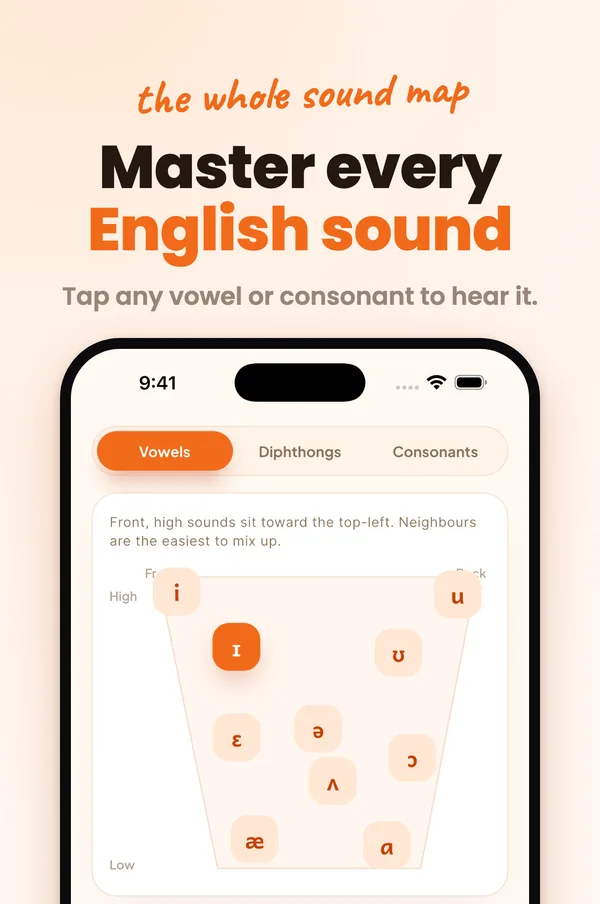
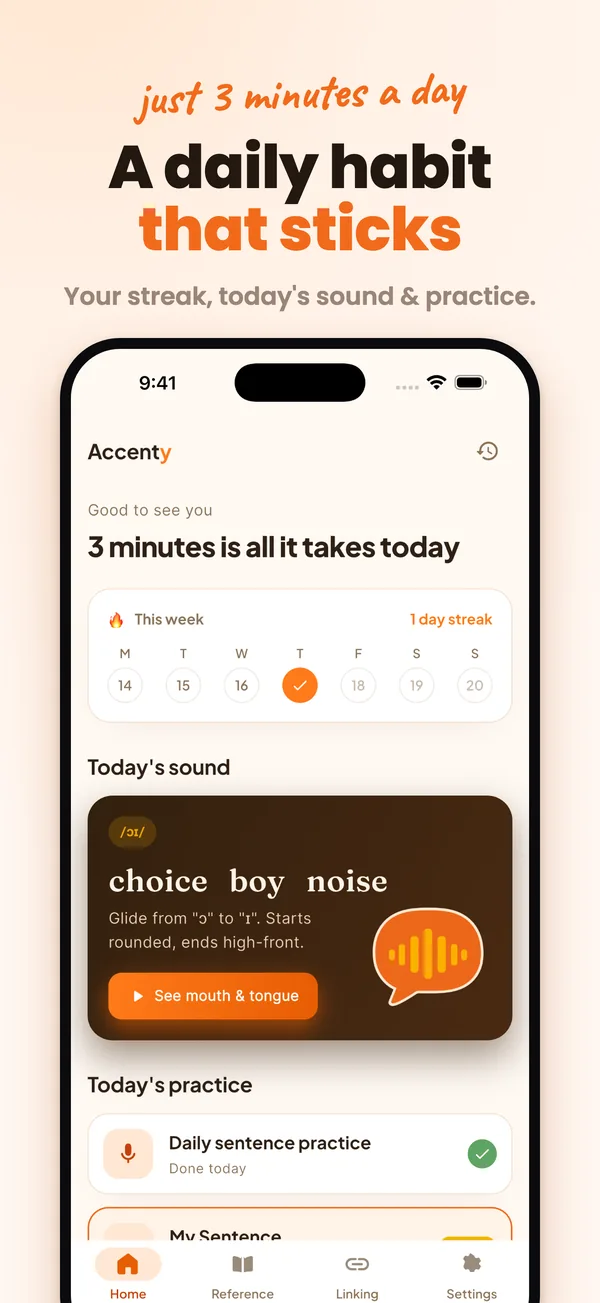
In Accenty every example plays a careful and a natural version, so you hear the difference. Then you shadow the natural one and keep your recordings. Start with the sounds themselves on the full sound chart.
Every rule, with audioThe sound mapA few minutes a day
Questions
What is connected speech?
Connected speech is what happens to words when they are said together at natural speed: they link, sounds change or drop, and small words shrink to weak forms. It is why "want to" sounds like "wanna" and "next day" loses its t.
Do I have to use linking to be understood?
You will be understood without it, but you will sound word by word, and it is harder to follow fast native speech if you do not know these patterns. Consonant-to-vowel linking and weak forms make the biggest difference.
Is connected speech the same in American and British English?
Mostly. Linking /r/ and intrusive /r/ are British, because British English drops the r after a vowel. The flapped t in "water" and "get it" is American. Everything else on this page happens in both.
What is a weak form?
The unstressed version of a small grammar word such as and, to, of, the, can, was or for. "Fish and chips" is said "fish ən chips". Using the full form everywhere makes speech sound stiff.