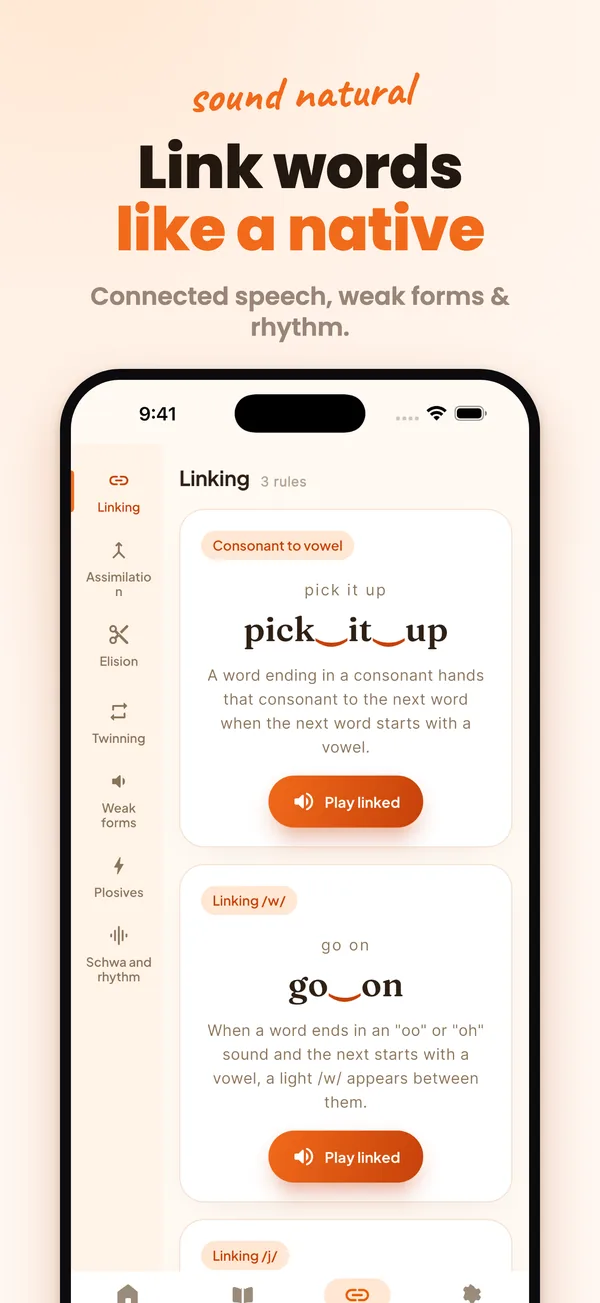
Read two sentences aloud. The free Accenty app shows your accent mix by country and the exact sounds that give it away, so you know what to practise first.
20 seconds
How the test works
Read aloud
Two sentences, up to 20 seconds, normal speed.
AI listens
Every consonant, vowel and the rhythm.
Your accent mix
A percentage by country.
Sounds to fix
Each one opens a mouth and tongue lesson.
Your accent scan
Korean
62%
American
30%
Other
8%
Sounds to work on/r/ · /l/ · /f/ · /θ/ · /ð/
Example result
What it listens for
Sounds your first language does not have
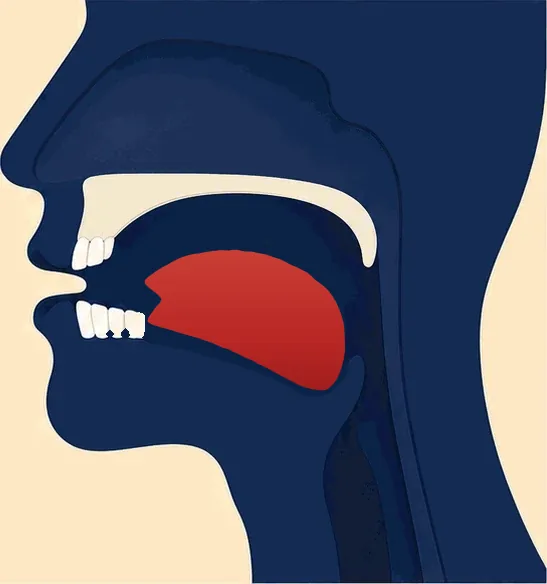
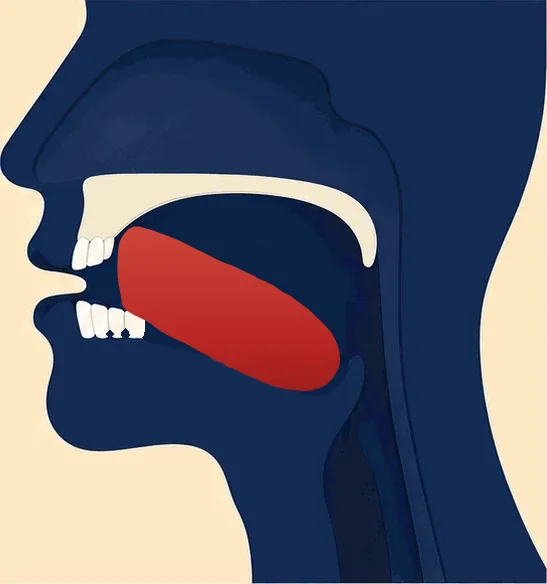
Missing sounds get replaced by the closest one you know. Here is rice vs lice, the pair Korean and Japanese speakers most often merge, in the app's own tongue animations.
/r/ right · rice
/l/ light · lice
8 accents
What gives each accent away
Korean
/r//l//f//θ//ð/
coffee→koppithink→sinkAll 4 patterns
No /f/–/p/ or /v/–/b/ split: "coffee" can sound like "koppi", "video" like "bideo".
English /r/ and /l/ blur together, so "rice" and "lice" sound alike.
The "th" sounds /θ ð/ become /s/ and /d/: "think" → "sink", "this" → "dis".
A short vowel slips between consonants, so clusters get stretched out.
Japanese
/r//l//v//f//θ/
milk→mirukuright→lightAll 4 patterns
One flap covers both /r/ and /l/, so "right" and "light" merge.
Vowels get added after consonants: "milk" → "miruku", "best" → "besuto".
The "th" sounds shift to /s/ /z/ or /d/; /v/ often becomes /b/.
Even, mora-timed rhythm, with each beat the same length and less word stress.
Mandarin Chinese
/θ//ð//r//v//l/
think→sinkthis→disAll 4 patterns
Final consonants are often dropped or softened: "like" can lose its "k".
Consonant clusters get simplified; "th" shifts to /s/ /z/ or /d/.
/r/ takes on a retroflex coloring; /v/ can slide toward /w/.
Pitch from a tonal language can make intonation rise and fall unexpectedly.
Spanish
/v//z//ʃ//ʒ//ɪ/
speak→espeakvery→beryAll 4 patterns
An /e/ is added before s-clusters: "speak" → "espeak", "school" → "eschool".
/b/ and /v/ merge, so "very" can sound like "bery".
/z/ becomes /s/ and /ð/ becomes /d/: "zoo" → "soo".
A five-vowel system blends English pairs like "ship" and "sheep".
Hindi
/w//v//θ//ð//z/
wine→vinethink→tinkAll 4 patterns
/v/ and /w/ merge: "wine" and "vine" sound alike.
t/d are made with the tongue curled back (retroflex).
The "th" sounds become dental /t/ /d/.
A distinctive, syllable-timed rhythm and intonation carries over.
Portuguese
/θ//ð//r//l//h/
Brazil→Braziwred→hedAll 4 patterns
A vowel is often added after final consonants: "hip-hop" → "hippy-hoppy".
Final /l/ turns into /w/: "Brazil" → "Braziw".
The "th" sounds become /t/ /d/ or /s/; nasal vowels carry over.
In Brazilian Portuguese, /r/ can sound like /h/: "red" → "hed".
French
/θ//ð//h//r//ɪ/
house→ousethink→sinkAll 4 patterns
The "th" sounds become /s/ /z/ or /t/ /d/.
Word-initial /h/ is often dropped: "house" → "ouse".
Stress lands on the last syllable, flattening English word rhythm.
/r/ is made in the back of the throat (uvular).
German
/w//θ//ð//v//z/
dog→dockwine→vineAll 4 patterns
Final voiced consonants are devoiced: "dog" → "dock", "have" → "haf".
/w/ becomes /v/: "wine" → "vine".
The "th" sounds shift to /s/ /z/ or /t/ /d/.
Some vowels are tenser or more rounded than their English counterparts.
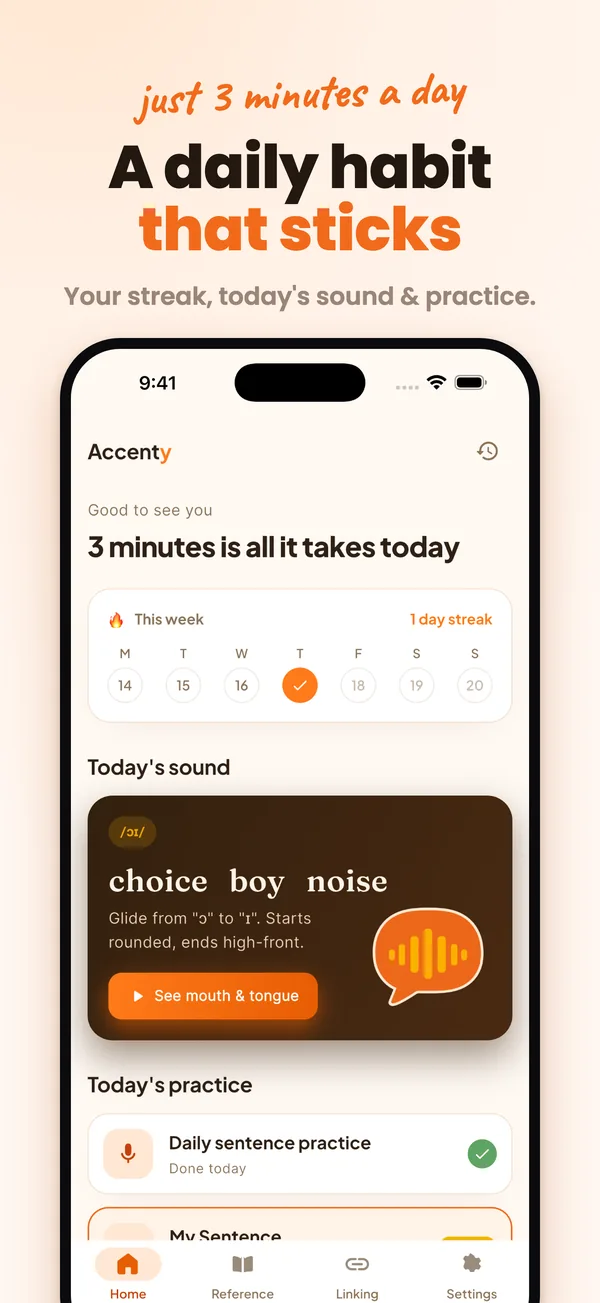
Lessons for every soundRead 3 minutes a day, with AI feedbackConnected speech and rhythm
Re-check weeklyScan again and compare your accent mix.
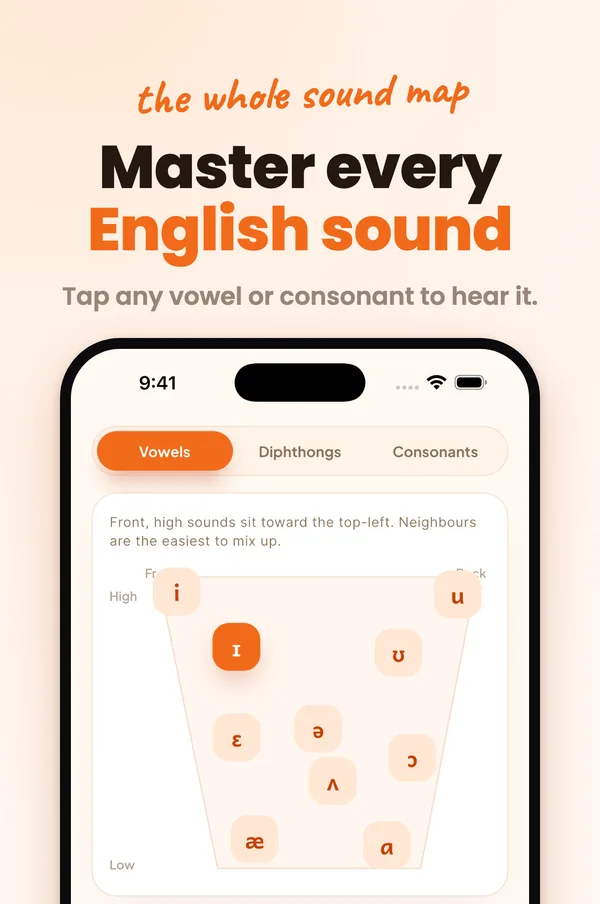
American or British46 or 44 sounds, your choice.
Questions
Is the accent test free?
Yes. The accent scan in Accenty is free, with a re-check once a week. No account is needed.
How accurate is an AI accent test?
It is an estimate from one short recording, so treat it as a practice guide rather than a professional assessment. Read in a quiet room, at your normal speed, and re-check after a few weeks of practice to see what changed.
What does the test listen for?
How each English sound comes out: consonants such as r, l, th, v and f, vowel pairs such as "ship" and "sheep", and the rhythm of the sentence. Those patterns are what make an accent recognisable.
Do you keep my recording?
No. The recording is sent to an AI model to analyse your pronunciation and is not kept after it is analysed. The result (your scores and sounds to work on) is stored with an anonymous ID.
Can I learn an American or a British accent?
Both. Pick the accent you want to learn in the app, and every sound and example follows it: 46 sounds for American English, 44 for British.